Introducing LibraryLink: Helping Libraries generate revenue from their deaccessioned materials.

Introducing LibraryLink: Helping Libraries generate revenue from their deaccessioned materials.

Austin Bulk Book Donation Pickup

Austin generates book donations from two very different sources — UT Austin's 50,000+ students clearing out at semester end, and a wave of tech companies that relocated here and left large professional libraries behind. We offer free book donation pickup across Greater Austin for collections of 30 or more boxes, with professional sorting and transparent reporting.
Serving South Congress, East Austin, Hyde Park & Greater Austin
We handle large-volume book donations for universities, nonprofits, and businesses across Greater Austin — with free pickup for qualifying collections.
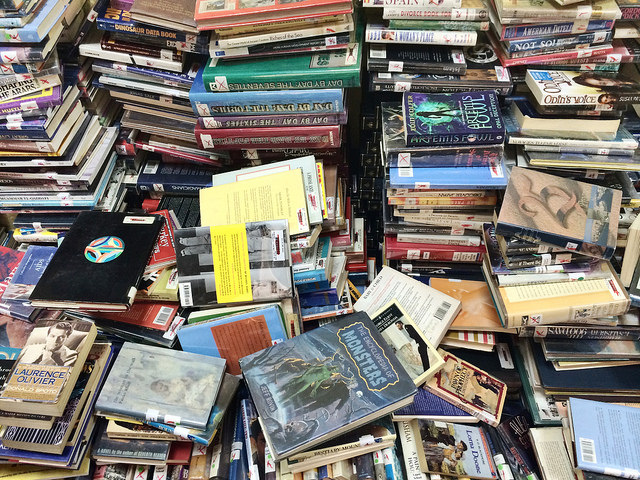
Austin is in an unusual position right now. The city is simultaneously managing large-scale academic donations from UT Austin — one of the largest universities in the country — and one-time corporate library decommissions from companies like Oracle, Tesla, and Apple that relocated here from other cities. Those corporate collections often contain valuable technical and professional books with strong resale demand, which tends to keep more Austin donations in active circulation rather than heading to recycling.
The biggest donation surges happen in May and August with UT Austin's semester move-outs, and again in January when New Year decluttering combines with the start of a new semester. Austin's summer heat — sustained 100°F+ temperatures from June through September — also means timing matters for storage. Books left in garages or vehicles during Texas summers deteriorate quickly. For May and August pickups, booking two to three weeks ahead is strongly recommended.
We coordinate pickups across Greater Austin — from South Congress (SoCo) and East Austin's creative neighborhoods to Hyde Park near UT's campus, Mueller's sustainable community development, and suburban hubs including Round Rock, Cedar Park, Pflugerville, and Georgetown. Wherever your books are in the metro, we can reach them.
Austin's donation calendar has a double peak that's unusual in Texas: the academic surge from UT Austin's May and August move-outs, and the rolling corporate wave from tech company relocations. We plan routes to handle both, and we build in January capacity for the New Year decluttering spike that's become a reliable fixture in Austin's donation calendar. Collections of 30+ boxes qualify for free coordinated pickup.
Austin's Zero Waste Strategic Plan sets clear diversion targets. Our reporting shows exactly how books were distributed — resale, literacy programs, or responsible paper recycling — with nothing going to landfill. For tech companies with ESG reporting requirements, this documentation is directly usable in sustainability disclosures.
Austin's combination of large-scale academic move-outs and unpredictable corporate library decommissions creates donation volumes that self-managed drives weren't built to absorb. When UT Austin and a major tech campus both need pickup in the same month, professional logistics coordination is the only approach that works at scale.
| Factor | Self-Managed Drives | Professional Pickup Service |
|---|---|---|
| Pickup logistics & transportation | Staff coordinate vehicles, storage, and donor handoffs without dedicated routes. One-time corporate decommissions don't fit recurring drive models, and UT Austin's volume alone can overwhelm informal programs. | We handle scheduling, routing, and transport for collections of 30+ boxes at no cost to the donor. Routes are planned around Austin's academic calendar and can accommodate the one-time large corporate pickups that don't fit a traditional drive schedule. |
| Storage & donation overflow | Storage capacity runs out during May and August campus clearances, causing delays and forcing sites to turn books away during the highest-need periods. | Regular large-volume pickups across South Congress, East Austin, and Greater Austin keep storage clear. Donor sites stay open year-round rather than shutting down during the peak weeks when donations are most available. |
| Donation outcomes & accountability | Difficult to track where books end up, which makes Zero Waste documentation and ESG reporting nearly impossible to complete accurately. | Detailed reporting on volume, resale rates, and literacy placements supports Austin's Zero Waste Strategic Plan and meets the ESG documentation standards that companies like Oracle, Tesla, and Apple need for annual sustainability filings. Learn more at <a href="https://zoombooks.ca/sustainability/">our sustainability page</a>. |
How bulk pickup works, where Austin donations come from, and what happens to your books after they leave.
Austin's book donation sources split fairly cleanly into two categories. The academic side is straightforward: UT Austin's ~50,000 students generate large volumes at every semester end, joined by St. Edward's University, Texas State in nearby San Marcos, and Huston-Tillotson. Estate clearouts in Hyde Park, Mueller, and Westlake Hills add consistent year-round volume, as do nonprofit storage cleanups in South Congress, East Austin, Round Rock, and Cedar Park.
The corporate side is newer and harder to plan for. Companies that relocated operations from San Francisco, Seattle, and New York brought substantial professional libraries — and when those companies moved into new Austin offices, they often discovered they had nowhere practical to put thousands of books. Oracle's Riverside Campus, Tesla's Gigafactory Texas, and Apple's Sunflower Campus have all generated significant one-time corporate library decommissions. The books tend to be high-quality technical and professional titles with real resale value.
Common sources of large Austin book donations:
The challenge isn't that Austin lacks book donation options — it's that the existing options weren't built for the volumes Austin is now generating. BookPeople, Austin Public Library, and Half Price Books are excellent for individual donors, but none of them run freight logistics for 500-box corporate decommissions or coordinate simultaneous multi-stop routes across UT Austin's 40 Acres during May move-out week.
Austin's summer heat compounds the problem. Books left in vehicles, garages, or storage units during June through September are at real risk of warping and mold. Getting large collections moved quickly and efficiently — rather than sitting through Austin's heat while a self-managed drive slowly works through the backlog — is a practical matter, not just a logistical preference.
What professional large-volume pickup provides:
See how our process works for a full breakdown of pickup through final distribution.
Austin's donation outcomes are shaped by what's being donated. Corporate tech libraries from relocated companies tend to contain recent programming, engineering, and business titles with strong academic resale demand — a higher percentage of these books stay in active circulation compared to a typical estate or campus donation. That's good for the overall impact picture and for the sustainability of free pickup service.
Austin's tech sector also has real ESG reporting requirements. When a company donates 500 boxes of professional books and can document that 80% were resold or distributed to Texas literacy programs, that's a concrete, reportable outcome — not just a gesture. We format impact reports to be directly usable in annual sustainability filings.
Typical Austin donation outcomes:
Review our approach to sustainability and responsible processing for more detail.
If your collection is under 30 boxes, or you're an individual donor rather than an institution, Austin has several good alternatives:
Austin Public Library: Accepts books in good condition at select branches. The Friends of the Austin Public Library runs regular book sales to support library programs.
BookPeople: Austin's independent bookstore on North Lamar occasionally accepts community donations. A good option for a small number of books, particularly local or literary titles.
Half Price Books: Multiple Austin locations. Buys and sells used books and offers store credit for donations — a practical option for medium-sized personal collections.
Goodwill Central Texas: Multiple metro locations for convenient drop-off of smaller donations.
When bulk pickup makes more sense (30+ boxes):
We also serve donors in other Texas cities — see our pages for Houston and Dallas if you have collections across multiple Texas locations.
Minimum Requirements Checklist
Ensure your collection meets our requirements for efficient, sustainable bulk donation processing
Bulk donations must consist of at least 30 properly packed boxes to qualify for our free pickup service.
Books should be boxed and arranged on pallets for efficient loading and warehouse processing.
Provide loading dock or ground-level access with clear instructions for our pickup team.
Book pickups 2-3 weeks ahead, especially during peak seasons (May, August, December).
Share where your books are stored, roughly how many boxes you have (30+ to qualify for free pickup), and your preferred timeline. For corporate collections, the subject matter — programming, engineering, business — is helpful to know in advance. We'll ask about building access and confirm logistics before scheduling.
We build your pickup into routes that account for Austin's dual academic and corporate donation peaks. For May and August pickups tied to UT Austin's move-out, we coordinate around the campus facilities schedule. For corporate campus pickups at Oracle's Riverside Campus, Tesla's Gigafactory Texas, or Apple's Sunflower Campus, we work with your facilities team directly. Schedule here or reach out through the contact form.
Austin donations are sorted into three streams: high-value tech, programming, and business books from corporate collections (evaluated for academic resale); educational and children's titles for BookSpring and the Literacy Coalition of Central Texas; and Zero Waste-compliant recycling for outdated or damaged materials. We track the outcome split — that's the data Austin's organizations need for ESG and sustainability reporting.
Impact reports show how many books were resold, redistributed to Texas literacy nonprofits, and recycled — with zero going to landfill. The format is aligned with Austin's Zero Waste Strategic Plan documentation and is directly usable in ESG filings. For UT Austin, St. Edward's, or other universities, the same reporting feeds institutional sustainability statements and grant applications.
For large collections of 30 or more boxes, we offer free pickup across Greater Austin — South Congress, East Austin, Hyde Park, and all surrounding metro areas including Round Rock, Cedar Park, and Pflugerville. For smaller personal donations, Austin Public Library, BookPeople, Half Price Books, and Goodwill Central Texas are all solid options throughout the metro.
Yes, for collections that meet our 30-box minimum. There's no charge for pickup, transport, or sorting. The service is funded by resale revenue from donated books in good condition.
Corporate tech collections from Oracle, Tesla, and Apple are particularly strong — recent programming, engineering, and business titles have real academic resale demand. UT Austin textbooks in recent editions also move well. For literacy programs, BookSpring and the Literacy Coalition of Central Texas welcome children's books and educational materials in good condition. Older programming titles (5+ years) have limited resale value given how quickly the field moves, but everything usable stays in circulation rather than going to landfill.
The busiest periods are May and August (UT Austin move-outs) and January (New Year decluttering plus semester start). During those months, booking two to three weeks ahead is strongly recommended. Austin's summer heat also makes scheduling promptly important — books deteriorate in 100°F+ conditions, so don't leave collections sitting in unshaded storage longer than necessary.
Yes. Oracle's Riverside Campus, Tesla's Gigafactory Texas, and Apple's Sunflower Campus all have modern freight infrastructure with good loading dock access, which makes large-volume pickups straightforward. We work with your facilities team to coordinate access and scheduling. These one-time large collections are one of the scenarios we're specifically set up for.
Yes. UT Austin's May and August move-outs are among the largest academic donation events in Texas. We coordinate with campus facilities to plan routes during the move-out window. The 30-box minimum applies, so this is best suited for departmental clearances, library deaccessions, or coordinated donation drives rather than individual dorm rooms.
Austin's summer heat is the main concern. Books stored in vehicles, garages, or unshaded storage during June through September are at real risk of warping and mold — move them to air-conditioned space before pickup if at all possible. For corporate collections from tech offices, organizing boxes by subject area (programming, business, engineering) speeds our sorting considerably. For UT Austin donations, having books boxed and accessible within the move-out window is critical. Share building access details — loading dock dimensions, freight elevator availability, parking restrictions — when you schedule.
Austin donations are sorted into three streams: resale (40–50%), with strong emphasis on tech, engineering, and professional development books from corporate collections; Texas literacy programs (30–35%) including BookSpring and Literacy Coalition of Central Texas; and responsible paper recycling (15–25%) — zero books to landfill. You receive detailed reporting aligned with Austin's Zero Waste Strategic Plan, formatted for ESG filings and corporate sustainability disclosures.
BookPeople and Austin Public Library are excellent for individual donors with smaller collections. We specialize in institutional donations of 30+ boxes that need coordinated logistics, multi-site pickup capability, and formal impact reporting. If you're managing a campus clearance, corporate decommission, or large nonprofit cleanup, those logistics requirements are well beyond what drop-off programs handle.

Tell us about your collection — size, location (anywhere in Greater Austin), and your timeline. We'll confirm whether it qualifies for free pickup and get something on the calendar. Reach out here or visit our book donations hub to learn more.
Related Resources
Learn how our LibraryLink program supports deaccessioning, pickups, and revenue for libraries.
Learn MoreDiscover our responsible book recycling process and how we keep books out of landfills.
Learn MoreSee how we help thrift stores manage surplus inventory with pickups and resale support.
Learn More