Introducing LibraryLink: Helping Libraries generate revenue from their deaccessioned materials.

Introducing LibraryLink: Helping Libraries generate revenue from their deaccessioned materials.
 Wholesale & Sourcing
A complete buyer's guide for Chinese importers, international schools, bilingual kindergartens, and English education companies sourcing wholesale English-language children's books from North America. Covers China's NRTA/GAPP content review requirements, customs duties (HS 4901 — 0% tariff), sea freight logistics to Shanghai, Shenzhen, and Guangzhou, and how Zoom Books pre-screens every shipment to prevent rejection at Chinese customs.
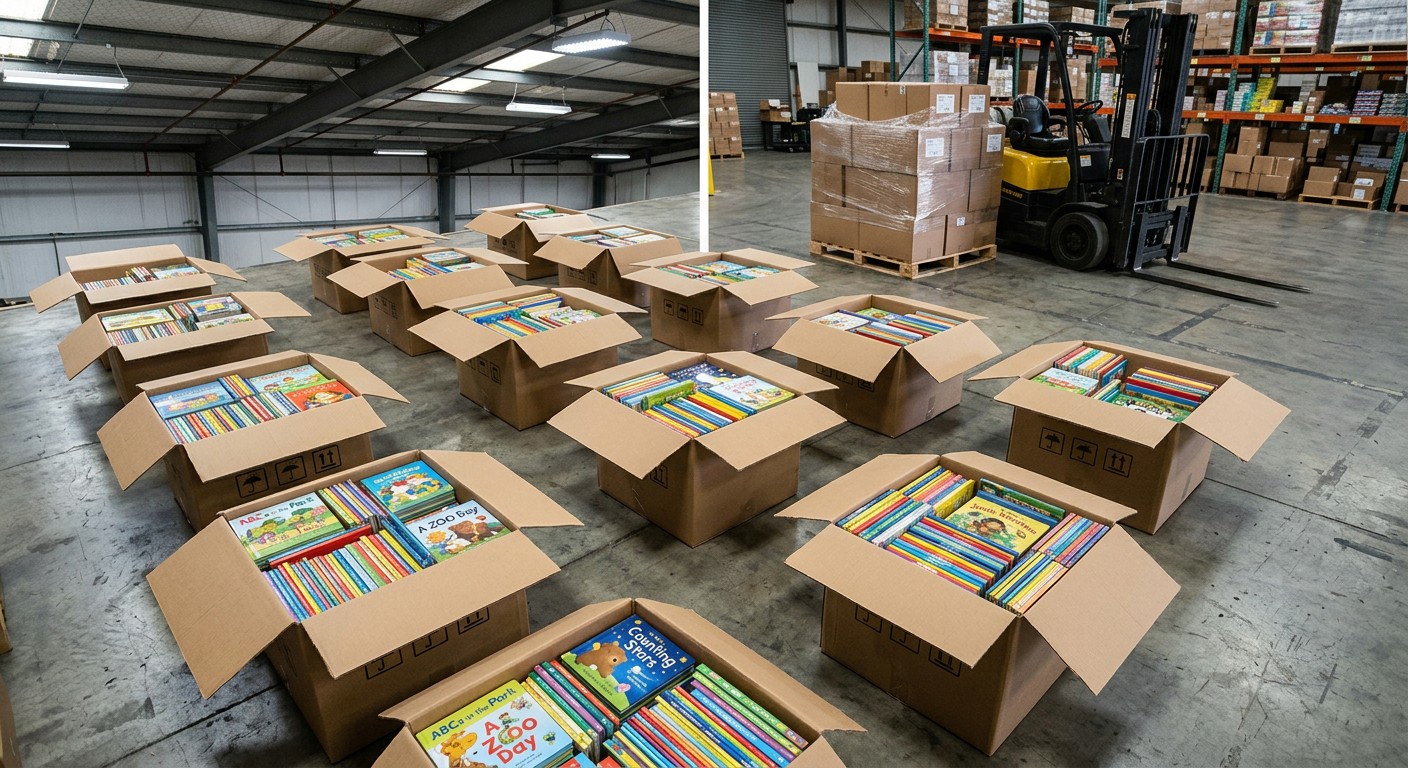
China’s English-language education market is one of the largest and fastest-growing in the world. International schools, bilingual kindergartens, English training centres, and corporate libraries all require a steady supply of quality English-language children’s books — and wholesale sourcing from North America offers a price advantage that domestic Chinese suppliers cannot match on used titles. But importing wholesale children’s books into China requires navigating a content review process that has no equivalent in most other markets.
Zoom Books ships bulk used English children’s books to international buyers including importers and distributors across mainland China. This guide covers everything a Chinese buyer needs to know: GAPP content review requirements, customs duties, shipping logistics to Shanghai, Shenzhen, and Guangzhou, condition grading, and why pre-screening for compliance is critical to keeping shipments moving.
Key Takeaway
China’s General Administration of Press and Publication (GAPP, now operating under NRTA) reviews imported publications for content compliance. Zoom Books pre-screens every China-bound shipment to remove titles that would trigger this review — preventing costly shipment rejections and customs delays before they happen.
Importing printed books into China is governed by a distinct regulatory framework that combines customs procedures with a content oversight system administered by the National Radio and Television Administration (NRTA) — which absorbed GAPP (General Administration of Press and Publication) functions. Understanding this framework is essential for any buyer sourcing English children’s books in bulk for the Chinese market.
Key regulatory elements include:
For buyers sourcing through a licensed Chinese import distributor (the most common commercial structure), the distributor manages the import qualification and customs filing. Your role as the end buyer is to ensure the books you source are content-compliant before they arrive at port.
The content categories that cause rejections for imported books entering China are well-documented in NRTA regulatory guidance. For children’s books specifically, the categories that most frequently create problems for North American imports include:
Important Note
A shipment rejection in China is more than a delay — it can result in the entire container being returned to origin at the importer’s cost, or destroyed at the port. The reputational and financial cost of a single rejection event typically exceeds the savings from buying from an unscreened supplier. Content compliance must be treated as a non-negotiable part of the sourcing process.
Zoom Books’ physical sorting facility reviews every book in a China-bound shipment before packing and sealing. Our team specifically removes titles that present NRTA/GAPP content compliance risk, including:
The result is a curated inventory of English-language children’s books that move through Chinese customs with minimum risk: picture books, early readers, phonics series, chapter books, and educational titles that serve international schools, bilingual kindergartens, and English education companies without triggering content review flags.
You can review Zoom Books’ full grading and sourcing workflow on the Our Process page.
0%
Import Duty Rate
on Printed Books (HS 4901)
22–30
Days Sea Freight
Canada → Shanghai
$1–3
Per Book
Wholesale Price (USD)
Under China’s Harmonised System tariff schedule, printed books fall under HS Code 4901. China applies a 0% Most Favoured Nation (MFN) import tariff rate on printed books — a policy that has been consistent across multiple tariff revision cycles.
In addition to the tariff rate, buyers must account for:
The practical landed cost for an importer: 0% tariff on the book value, plus approximately 9% VAT on the CIF value. For used books purchased at USD $1–3 per book wholesale, the VAT component adds roughly $0.09–$0.27 per book — a modest addition to landed cost that keeps North American used books highly competitive against domestically sourced alternatives.
Books from Zoom Books ship sea freight from Canada to China — the economics of per-book pricing make air freight unviable for bulk orders. Transit times and port options:
Zoom Books ships both LCL (Less than Container Load, consolidated with other cargo) and FCL (Full Container Load — 20ft or 40ft containers). LCL is standard for orders under approximately 5,000 books; FCL is the more cost-effective option above that threshold.
A standard 20-foot container holds approximately 12,000–15,000 children’s books; a 40-foot container holds 25,000–30,000. All FCL containers are sealed at the Zoom Books facility in Canada after pre-screening, minimising the risk of undocumented titles entering the shipment.
Understanding why wholesale English children’s books are in demand in China helps buyers position their inventory effectively. The demand drivers are structural:
Browse the children’s books wholesale page or the full Zoom Books wholesale catalogue to see what’s currently available.
Zoom Books grades all books using a standardised condition system. For China-bound buyers, grade selection typically aligns with the end use:
For China, buyers sourcing for international school libraries or bilingual kindergartens almost always require Grade A. Corporate and training centre buyers typically select Grade A/B mixed. All grades receive the same content pre-screening regardless of condition grade.
Genre-wise, the strongest demand from Chinese buyers:
International wholesale orders to China typically work at the following scale:
Buyers sourcing for multiple international schools or a chain of bilingual kindergartens often consolidate procurement across locations into a single FCL order to reduce per-book logistics cost. Contact the Zoom Books team via the contact page to discuss volume pricing for multi-location orders.
Chinese customs requires a standard set of import documents. Zoom Books provides all export-side documentation from Canada; your Chinese import agent or customs broker handles the import declaration filing (报关单). Key documents:
Note: China does not maintain a publicly searchable “approved publications” list for foreign children’s books equivalent to some other regulatory systems. Compliance relies on the pre-shipment content review process rather than a pre-clearance list — which is why sourcing from a supplier who performs that review at origin is the most reliable risk management approach.
Key Takeaway
China’s 0% import tariff on printed books means your landed duty cost is nil — VAT at approximately 9% of CIF value is the primary tax component. Content compliance, not tariff exposure, is the risk to manage. A compliant shipment clears customs; a non-compliant one can be rejected in full.
Do I need a publication import licence to bring books into China?
In China, the entity importing publications must hold an approved import qualification — this is the role of your designated Chinese import distributor or agent. As an end buyer (school, company, distributor), you source through that qualified entity. Zoom Books exports from Canada to your qualified Chinese import partner; the import filing is their responsibility.
Are Dr. Seuss books compliant for China?
Most classic Dr. Seuss titles (The Cat in the Hat, Green Eggs and Ham, One Fish Two Fish) are commercially sold in China and have no content issues. Certain later Seuss titles — particularly those touching on environmental or social themes — require case-by-case review. Zoom Books pre-screens these during our sorting process.
Can I request specific book series or authors?
Yes — for large orders (typically 2,000+ books), Zoom Books can target specific series or authors within our available inventory. We cannot guarantee specific titles, but we can target series, reading levels, and genre mixes. Submit your requirements when you contact us.
How does the CPTPP affect book imports to China?
China is not a member of the CPTPP (Comprehensive and Progressive Agreement for Trans-Pacific Partnership) as of 2026, though it has expressed interest in joining. Canada is a member. There is no preferential tariff arrangement between Canada and China specifically for books beyond the existing 0% MFN rate, which already makes tariff cost a non-issue.
Sourcing wholesale children’s books for the Indian market? See our guide on Wholesale Children’s Books for India — the compliance framework shares parallels with China but with distinct Indian customs requirements. For UK-market buyers, our Wholesale Books UK sourcing guide covers the UK import and VAT framework.
Ready to Get Started?
Tell us your volume, target genres, condition grade, and destination port. We’ll put together a quote with pre-screened, compliance-reviewed inventory ready to ship to Shanghai, Shenzhen, or Guangzhou.
 Wholesale Children’s Books for India: Bulk Sourcing with Import Compliance
 Wholesale Romance Books: A Buyer’s Guide for Resellers, Gift Shops, and Subscription Box Companies